
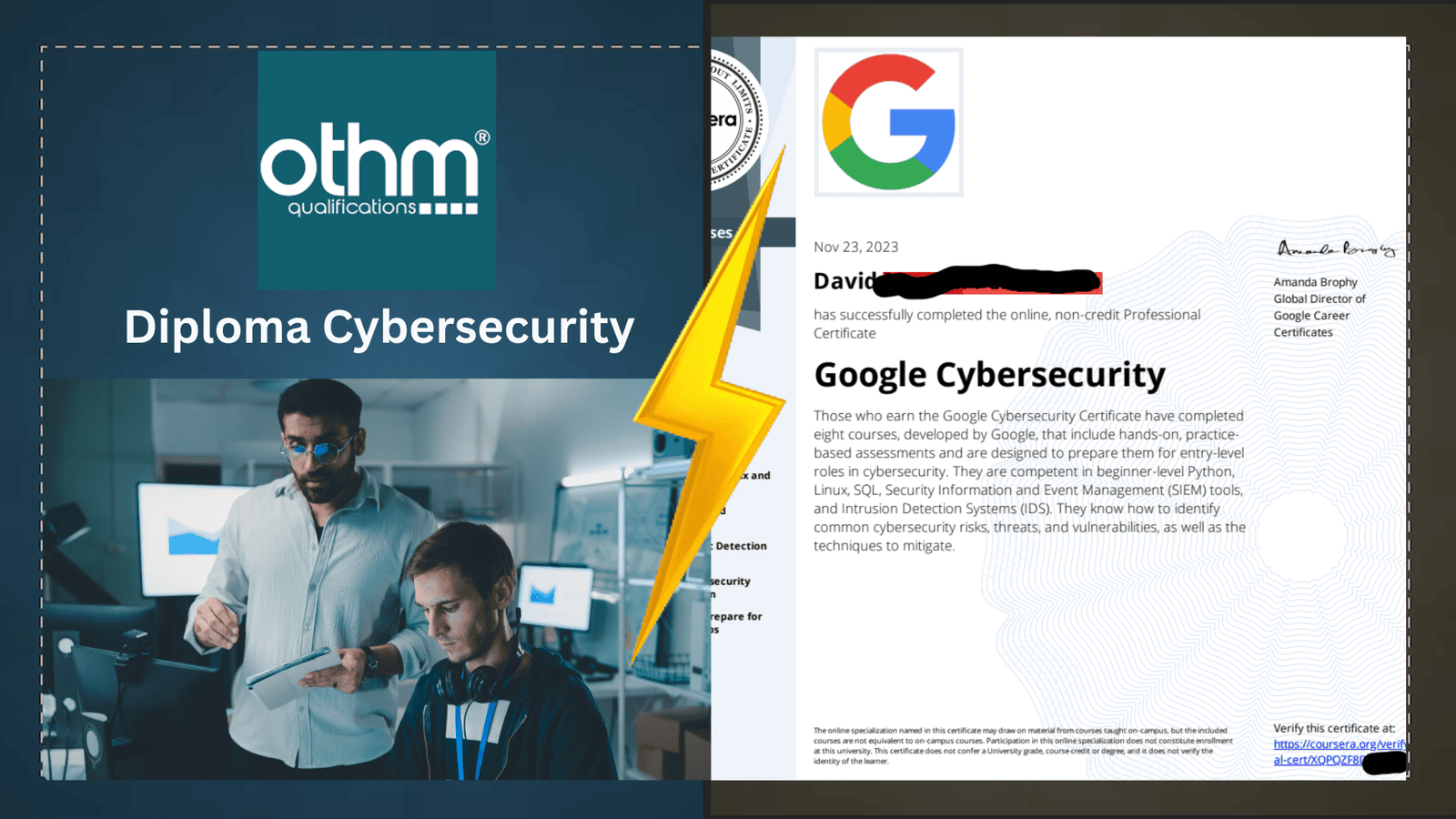
The comparison between the Google Cybersecurity Certificate and the OTHM Level 4 Diploma in Cyber Security is often presented as a simple choice between “industry” and “academia.” In practice, the distinction is far more nuanced, and misunderstanding it frequently leads students, particularly international learners, into strategic dead ends.
At the core, these two credentials are not competing products. They are answers to two fundamentally different questions.
The Google Cybersecurity Certificate is designed around a labour-market problem: how to help motivated beginners acquire operational cybersecurity skills quickly enough to enter junior roles. It is employer-led, tool-oriented, and intentionally pragmatic. Its logic is shaped by industry immediacy, what a Security Operations Centre expects a junior analyst to recognise, configure, or respond to in the first months on the job. As such, it privileges exposure over depth, familiarity over theory, and speed over formal assessment. This is not a flaw; it is the design principle.
The OTHM Level 4 Diploma, by contrast, is designed around an education-system problem: how to formally recognise that a learner has reached a level of academic and cognitive development equivalent to the first year of undergraduate study in a specialist field. Its logic is regulatory rather than commercial. Learning outcomes are mapped to the UK Regulated Qualifications Framework, assessments are externally moderated, and the qualification must demonstrate coherence, progression value, and academic rigour. The emphasis is not on whether a learner can operate a specific tool today, but whether they have developed the conceptual foundations required to advance tomorrow.
This difference in design intent explains why the two credentials behave so differently once they leave the classroom.
In the employment market, the Google certificate functions as a signal of readiness. It tells recruiters that the holder has encountered real cybersecurity concepts, understands the vocabulary of the field, and can be trained further without starting from zero. Its credibility is derived almost entirely from the reputation of Google itself and from alignment with current industry tools. However, this credibility is contextual and fragile: it depends on the employer recognising and valuing the certificate, and it does not accumulate formal educational capital. There are no academic credits, no recognised level, and no guarantee of acceptance beyond the hiring desk.
In academic and regulatory environments, the situation is reversed. Universities, qualification authorities, and immigration systems do not evaluate credentials based on brand prestige or market popularity. They ask different questions: Is this qualification regulated? At what level? How many guided learning hours does it represent? Does it provide progression rights? On these criteria, the Google Cybersecurity Certificate is largely invisible. It is not that it is “rejected”; it simply does not exist within the frameworks these systems use to make decisions.
The OTHM Level 4 Diploma, on the other hand, is legible to these systems. Its level is clear, its workload is documented, and its progression pathways are formally recognised. This is why it can be used for entry into Level 5 qualifications, foundation degrees, or even direct admission into the second year of certain undergraduate programmes. In international contexts, this regulatory clarity often extends into visa, residency, or professional recognition discussions, areas where informal certificates carry little weight.
Another subtle but important distinction lies in the type of learning each pathway cultivates. Professional certificates like Google’s are inherently convergent: they train learners to align with existing practices and tools. Academic diplomas like OTHM Level 4 are more divergent: they develop analytical capacity, ethical reasoning, and systems thinking that remain relevant even as tools and platforms change. In a field as volatile as cybersecurity, this distinction matters. Tools evolve quickly; conceptual understanding ages more slowly.
This is why learners who rely exclusively on short professional certificates often find themselves needing to “re-skill” repeatedly without ever accumulating recognised progression. They gain employability signals but not educational momentum. Conversely, learners who pursue purely academic routes without exposure to industry practices may struggle to translate their knowledge into immediate workplace value.
The real strategic insight, often missed in surface-level comparisons, is that these two credentials are complementary rather than substitutive. Used together and in the right sequence, they address each other’s blind spots. The OTHM Level 4 Diploma provides the structural legitimacy: a recognised level, a clear academic position, and access to further education. The Google Cybersecurity Certificate provides market fluency: familiarity with tools, scenarios, and employer expectations.
For institutions, this distinction is equally critical. Offering or recommending a Google certificate alone positions an organisation as a training provider, not an academic pathway builder. Offering an OTHM diploma establishes academic credibility but may require additional effort to demonstrate immediate employability relevance. Institutions that understand the nuance can design pathways where regulated qualifications anchor the learner’s trajectory, while professional certificates enhance their market signal.
In short, the difference between the Google Cybersecurity Certificate and the OTHM Level 4 Diploma is not about quality or prestige; it is about function. One accelerates entry into practice, the other secures position within an educational and regulatory ecosystem. Confusing these roles leads to frustration. Understanding them allows learners-and institutions-to design pathways that are both credible and competitive.