
The Power of Vocational Education
An Evidence-Informed Analysis
10/06/2025
Abstract
Vocational education and training (VET) rarely makes headlines, yet the data tell a persuasive story: high-quality VET keeps more young people engaged in learning, propels them into further study or skilled work, and can soften the blows of economic change. Drawing on recent causal syntheses, international skills surveys and long-run labour-market studies, this article distils what we now know about the power of vocational pathways and the conditions that let that power flourish.
1.Beyond the 'academic-vocational' split
The old caricature sets academic study on a pedestal and vocational study as its pragmatic but inferior cousin. Modern evidence paints a subtler picture. VET programmes that teach rigorous technical content and cultivate transferable skills are neither a comfort-blanket for low achievers nor a dead-end; they are an alternate route to professional citizenship.
Policy frameworks such as England’s T Levels and Australia’s High-Quality CTE Programme of Study recognise this by weaving employer-endorsed curricula with clear progression into higher qualifications. The research base now lets us say more precisely why that blend matters.
2. What the numbers show
| Outcome domain | Direction & magnitude of VET impact | Key source |
|---|---|---|
| Staying in school | +3–14 pp increase in on-time secondary completion | Impact of Career and Technical Education: A Systematic Review of the Research |
| Academic achievement | Small but significant gains (≈0.09 SD) in GPA/test scores | Impact of Career and Technical Education: A Systematic Review of the Research |
| College transitions | Higher 2-year college entry; neutral on 4-year entry | Impact of Career and Technical Education: A Systematic Review of the Research |
| Employability skills | +0.12 SD on work-readiness indices | Impact of Career and Technical Education: A Systematic Review of the Research |
| Employment probability | +2–4 pp in early career; wage effects depend on level | THE EFFECTIVENESS OF VOCATIONAL EDUCATIONIN PROMOTING EQUITY AND OCCUPATIONAL MOBILITY AMONGST YOUNG PEOPLE |
2.1 Keeping students in the game
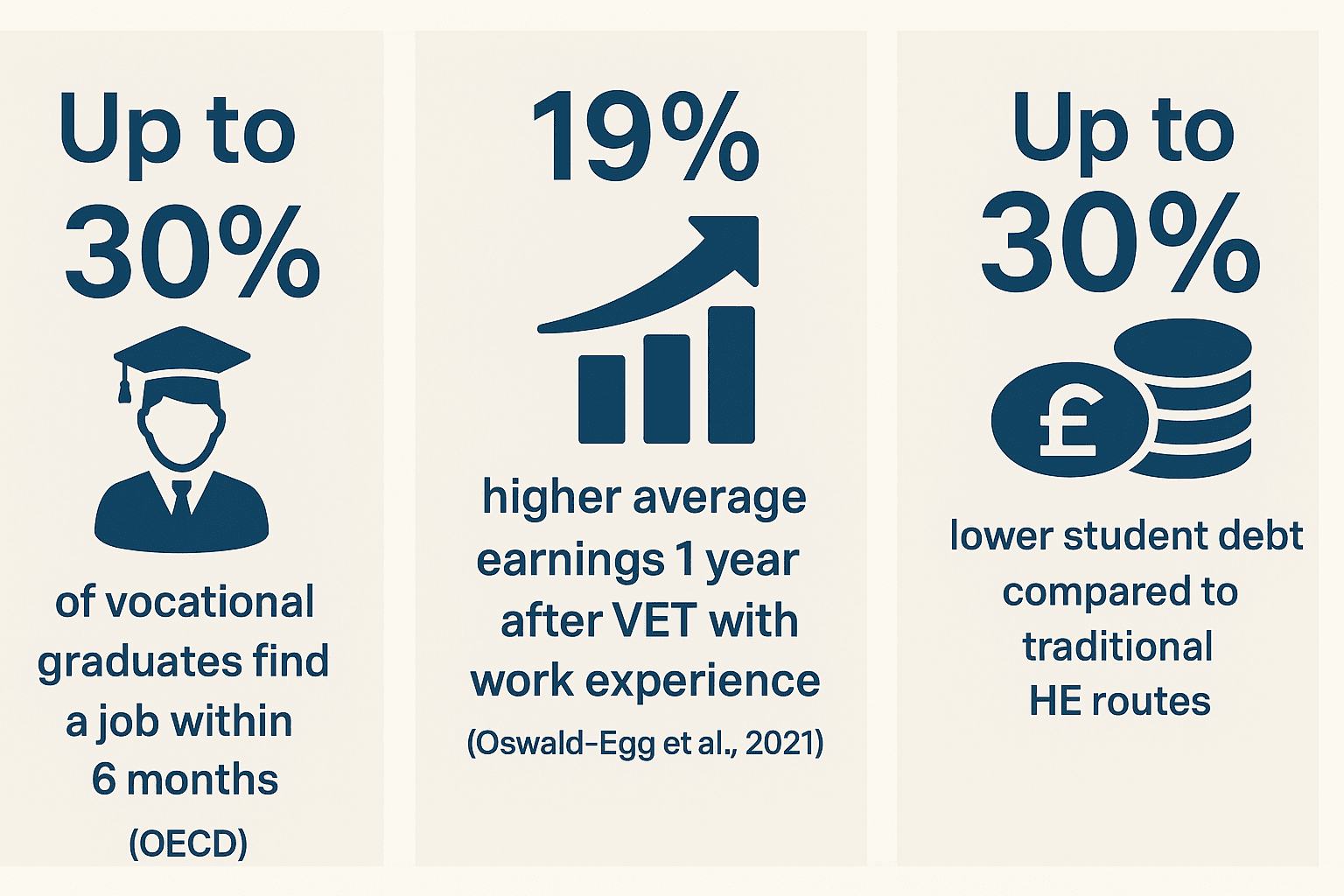
A 20-year meta-analysis of causal studies found that VET participation cut dropout rates and lifted high-school completion by roughly one student in ten (Lindsay et al., 2024). Much of that effect comes from programmes anchored in real workplaces, career academies, technical colleges and hybrid “schools within schools”, that transform learning from an abstract exercise into a tangible craft.
2.2 Post-secondary and lifetime returns
The same synthesis shows VET learners are more likely to step into community or technical colleges, often combining work with study. Longer-term wage premiums are nuanced: apprentices and associate-degree holders do well, whereas some short vocational certificates depreciate unless topped up. Bartlett’s (2009) cross-country review concludes that returns are highest where VET is “dual-purpose”, offering both occupational identity and avenues into higher learning
2.3 Skills for an uncertain labour market
PIAAC, the world’s largest adult-skills survey, reveals that workers with vocational upper-secondary backgrounds score slightly below general-education peers in literacy and numeracy, yet they enjoy longer cumulative employment and narrower skill-wage gaps than is often assumed (Bartlett’s, 2009). The message here is that technical routes produce employable adults, but the curricula must keep refreshing the foundational skills that let people retrain later.
3. Equity dividends
Tracking students too early can entrench social divides, but scrapping vocational options altogether harms the very learners comprehensive schooling hopes to lift. Karmel’s historical audit of Australian VET shows how transparent outcome indicators, completion numbers, cost-per-graduate, and employment gains, help governments fund quality without diluting accessibility (Lindsay et al., 2024).
4. Design principles for a modern EuroPolytech
Pathways, not cul-de-sacs – Every Level 3–5 and level 7 programmes should articulate seamlessly into degree-level study or higher technical qualifications to reward ambition instead of capping it.
Authentic work integration – Use multi-year employer partnerships and paid placements to deepen technical mastery and professional networks.
Dual metrics of success – Track both learning gains (skill growth, credential attainment) and labour outcomes (time-to-employment, earnings velocity). Publish them.
Adaptive core curriculum – Blend sector-specific practice with English, numeracy and digital fluency, communication and career planning so graduates can pivot as industries evolve.
Equity filters – Audit admissions, teaching and assessment for gender, socioeconomic and ethnic bias; subsidise catch-up modules where prior attainment gaps exist.
Conclusion
Vocational education is not a second-class ticket, it is a different service to the same destination for a skilled, adaptable, and socially mobile workforce. When programmes are well-designed and funded, future-proofed and linked to higher study, they deliver measurable academic, economic and equity gains. That is the quiet power EuroPolytech Academy can harness to turn practical talent into national and international advantage.
Dr. Amine Belmejdoub (PhD)

References
Bartlett, W. (2009). The effectiveness of vocational education in promoting equity and occupational mobility amongst young people. Ekonomski anali, 54(180), pp.7–39. doi:https://doi.org/10.2298/eka0980007b.
Brunello, G. and Rocco, L. (2017). The effects of vocational education on adult skills, employment and wages: What can we learn from PIAAC? SERIEs, [online] 8(4), pp.315–343. doi:https://doi.org/10.1007/s13209-017-0163-z.
Lindsay, J., Hughes, K.L., Dougherty, S.M., Reese, K. and Joshi, M. (2024). What we know about the impact of career and technical education: a systematic review of the research. [online] CTE Research Network. Career and Technical Education Research Network. Available at: https://cteresearchnetwork.org/resources/2024-systematic-review [Accessed 14 Jun. 2025].